Intel brought a few more chips home from Taiwan this week, with a new round of budget-oriented Core Series 3 processors fabbed right in the US-of-A.

The chips are the latest on Intel 18A, a 2nm class process node the x86 maker began producing at its Hillsboro and Chandler wafer fabs late last summer. The return home comes after much of Intel’s client portfolio was outsourced to TSMC in 2024.
The new chips are essentially a cut-down version of the Core Ultra Series 3 processors Intel launched at CES in January. The majority of the chips feature up to six CPU cores, spread across two of Intel’s high performance Cougar Cove cores and four low power Darkmont efficiency cores.
In terms of graphics, most of the chips feature 2 Xe3 graphics cores, two fewer than Intel’s base model Core Ultra processors, along with a somewhat pokey NPU good for between 15 and 17 INT8 TOPS of local AI performance.

That means these chips won’t qualify for Microsoft’s Copilot+ stamp of approval, which some may consider a pro rather than a con. Intel is keen to point out that combined, the NPU, GPU, and CPU are good for up to 40 platform TOPS, just not all at once.

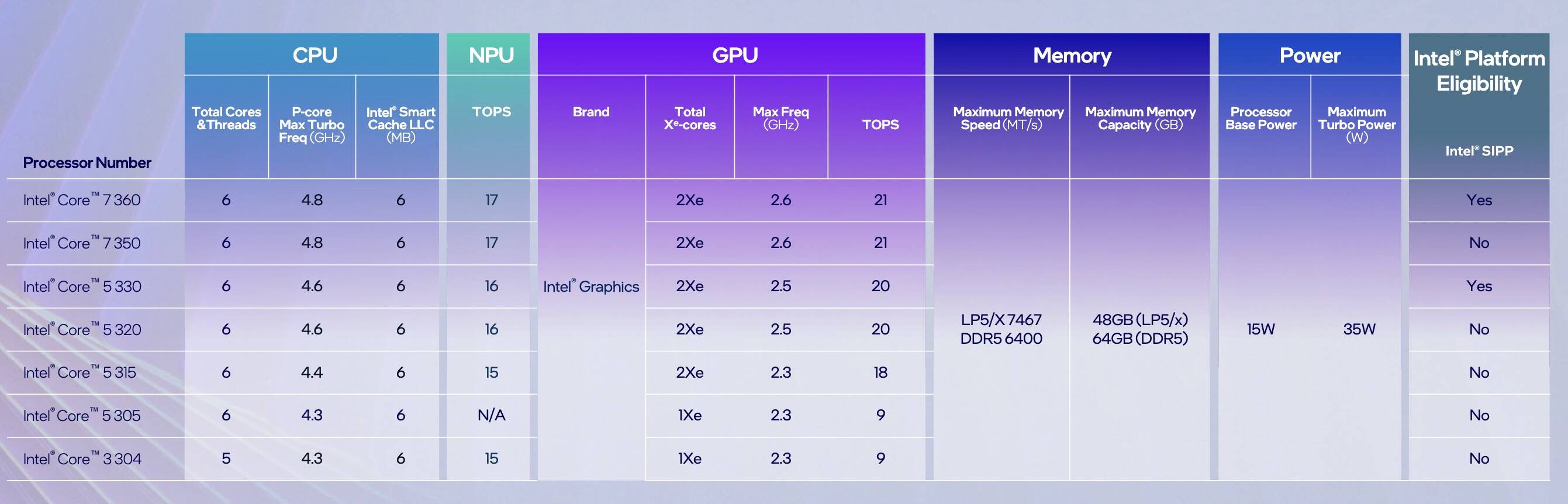
Here’s a quick rundown of Intel’s latest ‘Merica-made CPUs – Click to enlarge
All that compute is fed by up to 48 GB of LPDDR5 7467 MT/s or 64 GB of user serviceable DDR5 6400 MT/s memory. But with only a single memory channel, bandwidth is halved compared to Intel’s beefier Core Ultra Series 3 parts.
In fact, looking at the SKU list, the biggest difference between the chips comes down to CPU, NPU, and GPU clocks. CPU boost frequencies range from 4.3 GHz at the low end to 4.8 GHz for the top specced Intel Core 7 360. Meanwhile, GPU clocks range from 2.3 GHz to 2.6 GHz.
The odd chip out is Intel’s Core 3 304, which has had one of the CPU’s performance cores and one of its GPU cores fused off.
The Core Series 3 processors may not have the most or even fastest cores, but Intel argues the chips still represent a solid upgrade path for those still holding on to older 11th-gen Tiger Lake processors.
In Cinebench 2024, Intel claims its 15 W Intel Core 7 360 delivers 47 percent higher single threaded performance and 41 percent higher multi-core performance over the now 5.5-year-old part.
Having said that, we suspect Intel’s new Core processors’ real competition will come in the form of Apple’s MacBook Neo, which also sports a 6-core processor with a similar BIG:little arrangement.
In terms of I/O, the chips feature integrated support for up to 2x Thunderbolt 4, and 2x USB 3.2 ports, WiFi 7, Bluetooth 6, and more USB 2.0 ports than we recall seeing on a notebook in the last decade.
Intel says the chips will appear in more than 70 partner designs, with the first systems available on Thursday. However, that doesn’t just include notebooks. Intel is also positioning the part as a low-power edge processor that’s competitive with systems like Nvidia’s Jetson Orin Nano for object detection, image classification, and video analytics workloads. Intel expects edge systems to begin shipping later this quarter. ®
